Storage system selection is most effective after decluttering, when the actual volume and type of what needs storing is clear. Choosing storage before reducing excess often results in buying more than necessary or selecting the wrong format for the actual items.
This guide covers the main storage system categories available in Canada, their constraints, and the questions that help narrow down which approach suits a specific room and living situation.
.jpg)
Questions to answer before selecting a system
Three factors determine which storage system is appropriate before product comparisons begin:
- Ownership status: Renters in Canada generally cannot permanently modify walls or install built-in systems without landlord consent. This rules out anchored closet systems and built-in shelving in most rental situations.
- Wall and floor material: Older Canadian homes (pre-1960) frequently have plaster walls, which require different anchoring hardware than modern drywall. Concrete basement walls need masonry anchors. Not all retail storage kits account for this.
- What is being stored: Heavy items (books, tools, canned goods) need different structural support than clothing, linens, or light accessories. Overloading a particleboard shelf designed for clothing with books is a common cause of storage system failure.
Freestanding units
Freestanding shelves, bookcases, and drawer units require no wall anchoring and are the default choice for renters. The tradeoff is stability — taller freestanding units should still be anchored to a wall stud wherever possible, especially in homes with children. IKEA's SEKTION, Kallax, and Billy systems, available at Canadian IKEA locations, are among the most commonly used due to wide availability and modular sizing. Costco and Canadian Tire carry metal shelving units suited to garages, basements, and utility areas.
Anti-tip furniture straps attach to a wall stud and the back of the furniture without permanent damage in most cases. These are inexpensive and available at most Canadian hardware stores (Home Hardware, Home Depot Canada, Rona). Check with your landlord if your lease has specific conditions about wall fasteners.
Modular wall shelving
Wall-mounted modular shelving — systems using vertical track rails anchored to studs, with adjustable shelf brackets — provides more load capacity per dollar than most freestanding options. They are well-suited to home offices, living rooms, and garage walls.
In Canada, track-and-bracket systems are available at Home Depot, Lowe's, and Home Hardware under various brand names including ClosetMaid, Rubbermaid FastTrack, and Elfa (through The Container Store, which has Canadian locations in Toronto, Calgary, and Vancouver). Wall anchoring requires locating studs correctly, which matters more in older Canadian homes with irregular stud spacing.
Closet organization systems
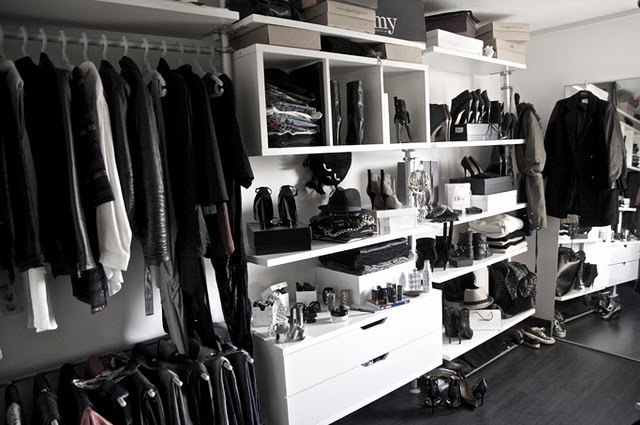
Standard closet organizers divide into two categories: tension-based systems that wedge between walls without anchoring, and track-mounted systems that screw into walls or the closet floor. Tension systems are appropriate for rental situations; track systems offer more stability and adjustability for homeowners.
.jpg)
IKEA's PAX wardrobe system is a full-width freestanding option that functions similarly to a built-in closet without requiring wall anchoring. It is sized to standard Canadian closet rough-in dimensions in many cases, though custom closet dimensions common in older homes may require measurement before purchase.
Closet depth matters
Canadian closets built before 1970 are frequently shallower than modern standards — 18 to 20 inches deep rather than the 24-inch standard. Most off-the-shelf hanging organizers and closet systems assume 24-inch depth. Verify depth before purchasing any system with hanging rods positioned at the back.
Small item and drawer storage
For craft rooms, home offices, workshops, and kitchen drawers, small-item storage is a separate category. Stackable drawer units, parts cabinets, and pegboard systems address different organization problems than shelf or closet systems.
Pegboard is particularly useful in garages and utility areas — it allows tool storage to be visible and accessible without dedicated cabinetry. Pegboard and hooks are available at most Canadian hardware retailers and can be mounted on a secondary frame to avoid direct wall contact if preserving rental walls is a concern.
Approximate cost ranges in Canada
Prices vary by retailer and region, and fluctuate with supply conditions. The following ranges reflect general market conditions as of 2025-2026:
- Basic freestanding shelf unit (metal, 5-tier): $40–$120 CAD at Costco, Canadian Tire, or Home Depot
- Modular closet system (tension-mounted, single closet): $80–$250 CAD
- Track-and-bracket wall shelving (per 4-foot section): $30–$80 CAD for components
- IKEA PAX wardrobe (basic single unit): $200–$500 CAD depending on size and interior fittings
- Custom closet organizer (professionally installed): $1,000–$4,000+ CAD depending on size and materials
Maintenance and longevity
Particleboard and MDF storage systems — the most common material in budget-range products — are sensitive to moisture. In Canadian basements, which can experience high humidity during summer months, solid wood or metal systems outlast particleboard significantly. A dehumidifier running during summer helps extend the life of any particleboard storage in below-grade spaces.
Related reading: Maximizing small-space living in Canadian apartments addresses storage layout for condos and smaller rental units where system selection intersects with floor plan constraints.